

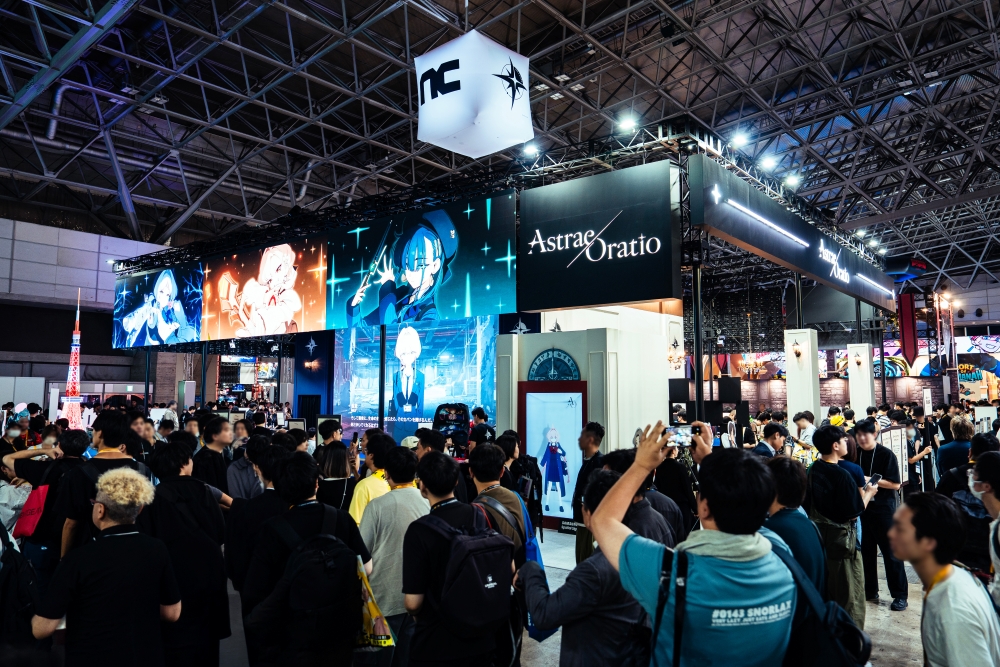
At the Tokyo Game Show (TGS) 2026, which took place from September 17 to 20 at Makuhari Messe in Chiba, Japan, Samsung Electronics and NC are setting a new benchmark for fan engagement. They showcased the potential of glasses-free 3D Spatial Signage to bridge digital and physical realms by bringing Astrae Oratio, an upcoming urban fantasy RPG, to life.
Enhancing Fan Engagement Through Spatial Integration
The central challenge for game publishers and intellectual property (IP) owners has been to translate digital characters into tangible experiences. NC, a globally recognized game developer and publisher, leveraged an 85-inch Spatial Signage display at their booth entrance. This installation, designed to resemble an elevator, introduced characters from Astrae Oratio at near life-size. Featuring Samsung’s proprietary 3D Plate technology, the display achieved a compelling sense of depth without needing 3D glasses, thereby infusing the game’s magical world into the physical environment.
Yongsoo Lee, Head of the Astrae Oratio Business Division at NC, remarked, “We aimed for visitors to experience the characters at life-size and immerse in the game’s universe immediately upon entering the booth. The liveliness and realism of characters in the subculture genre are crucial, and we saw Samsung Spatial Signage as the key to achieving this.”
The scale, motion, and depth provided by the display elicited immediate responses from attendees. Content creator Kawaii CoCo noted the character’s interactive feel, which enhanced its appeal for social media sharing. She stated, “It was dynamic and engaging, perfect for capturing and sharing with my audience.”
Maximizing Space While Creating Visual Impact
Samsung’s Spatial Signage, despite its slim 52mm profile, offers a deep visual impression, creating a perception of space extending beyond the screen. This was highlighted by booth visitor Daniel Acero, who said, “It didn’t look like a screen at first glance; it seemed like a transparent window into another world, providing a strong depth sensation.”
Further enhancing the booth experience, smaller 32-inch Spatial Signage displays, with an even slimmer 49.4mm profile, were strategically placed in waiting areas and along visitor routes. This setup allowed for flexible usage in constrained areas, maintaining visitor engagement with the game’s universe.
Visitor Tomas Portier commented on the extended engagement, “Spatial Signage made waiting more enjoyable by providing lively character interactions, a significant upgrade from static images.”
For retailers and venue operators, Samsung’s technology offers a solution that combines visual impact with spatial efficiency. Yongsoo Lee noted, “The slim design of Spatial Signage facilitated easy installation and optimal space usage, even allowing for merchandise storage behind the displays.”
Beyond Gaming: Expanding Application Horizons
The deployment at Tokyo Game Show is part of a broader application spectrum for Samsung’s Spatial Signage across various sectors such as entertainment, retail, and events. It has been used at Everland Safari World in Korea and the Governors Ball Music Festival in the United States, showcasing its versatility in integrating digital content into physical spaces.
Industry professionals and visitors see potential applications beyond gaming events. Rio Matsushita suggested similar setups in areas like Akihabara, while Nicolas Felix highlighted use cases in commercial branding and theme parks. These insights underscore Spatial Signage’s capacity to innovate content delivery across diverse environments.
