


Rising Stroke Incidence, Expanding Rehabilitation Infrastructure, and Technology Adoption Accelerate Global Market Growth
Austin, United States, March 03, 2026 (GLOBE NEWSWIRE) — Neurorehabilitation Market Size & Growth Analysis:
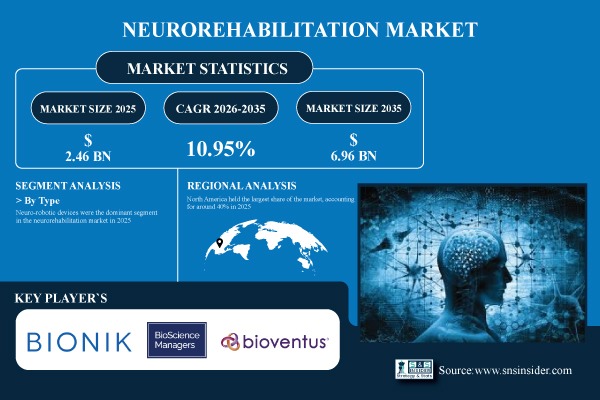
According to SNS Insider, The Neurorehabilitation Market size is estimated at USD 2.46 billion in 2025 and is expected to reach USD 6.96 billion by 2035, growing at a CAGR of 10.95% over 2026-2035. The growth of the market is driven by increasing prevalence of neurological disorders, rising stroke incidence rates, and technological advancements in rehabilitation equipment.
Market Size and Forecast:
- Market Size in 2025: USD 2.46 billion
- Market Size by 2035: USD 6.96 billion
- CAGR: 10.95% from 2026 to 2035
- Base Year: 2025
- Forecast Period: 2026–2035
- Historical Data: 2022–2024
Get a Sample Report of Neurorehabilitation Market: https://www.snsinsider.com/sample-request/1261
The U.S. neurorehabilitation market is projected to develop at a compound annual growth rate (CAGR) of 10.98% from 2026 to 2035, from an estimated USD 0.94 billion in 2025 to USD 2.66 billion by 2035. Due to its sophisticated healthcare system, high rate of stroke and traumatic brain injuries, and extensive network of rehabilitation facilities, the United States has the greatest market for neurorehabilitation.
Rising Prevalence of Neurological Disorders and Stroke Incidence Augment Market Growth Globally
As the world’s population ages, lifestyle-related health conditions rise, and the number of traumatic brain injury cases from accidents and sports-related incidents rises, the prevalence of neurological disorders and stroke incidence take center stage as growth drivers for the neurorehabilitation market share. These functional recovery and quality of life enhancement solutions are propelling the industry’s foundation, expanding its market share globally, and penetrating the markets for hospitals and rehabilitation facilities.
Market is Witnessing Slow Growth Owing to High Equipment Costs and Limited Reimbursement Coverage
The growth of the neurorehabilitation market is also hampered by high equipment costs and limited reimbursement coverage of advanced neurorehabilitation devices, since many patients and rehabilitation facilities struggle to afford robotic therapy systems and obtain insurance-covered advanced rehabilitation services. For neurological recovery programs, this could result in underutilization, limited patient access, and fewer therapy sessions. In areas where healthcare resources are limited and rehabilitation service reimbursement systems are still in their infancy, and this leads to poor patient outcomes and slowed market growth.
Major Neurorehabilitation Companies Analysis Listed in the Report are
- Ekso Bionics Holdings, Inc.
- Hocoma AG (DIH Medical Group)
- Bionik Laboratories Corp.
- Medtronic plc
- Abbott Laboratories
- Boston Scientific Corporation
- ReWalk Robotics Ltd.
- Tyromotion GmbH
- BioxtremE S.L.
- Kinetic Muscles Inc.
- Motek Medical B.V.
- Ectron Ltd.
- Helius Medical Technologies, Inc.
- MindMaze Holding SA
- Neurostyle Pty Ltd.
- Kinestica Limited
- Fourier Intelligence
- Myomo, Inc.
- Neuronetics, Inc.
- BrainQ Technologies Ltd.
Segmentation Analysis:
By Type
The neuro-robotic devices segment accounted for the highest revenue share of approximately 47.82% in 2025, owing to proven clinical efficacy in motor function recovery, widespread adoption in rehabilitation facilities, and strong evidence base supporting therapy outcomes. The brain-computer interfaces segment is anticipated to achieve the highest CAGR of nearly 12.34% during the 2026–2035 period, driven by the breakthrough innovations in neural signal processing, declining technology costs, and expanding research applications.
By Application
By 2025, the brain stroke segment contributed the largest revenue share of 32.56% due to high global stroke incidence rates, established rehabilitation protocols and comprehensive insurance coverage for stroke recovery programs. The traumatic brain injury segment is projected to grow at the highest CAGR of about 11.67% between 2026 and 2035 due to the growing number of road traffic accidents and sports-related head injuries.
By End-User
The rehabilitation centers accounted for the largest share of the neurorehabilitation market with about 44.18%, owing to their specialized focus on recovery programs, dedicated therapy infrastructure, and comprehensive multidisciplinary rehabilitation teams. Hospitals are slated to grow at the fastest rate with a CAGR of around 11.23% throughout the forecast period of 2026–2035, as acute care facilities seek integrated neurorehabilitation departments, early mobilization protocols, and seamless care transition pathways.
Need Any Customization Research on Neurorehabilitation Market, Enquire Now: https://www.snsinsider.com/enquiry/1261
Neurorehabilitation Market Segmentation
By Type
- Neuro-Robotic Devices
- Non-Invasive Stimulators
- Brain-Computer Interfaces
By Application
- Brain Stroke
- Parkinson’s Disease
- Multiple Sclerosis
- Spinal Cord Injury
- Traumatic Brain Injury
- Cerebral Palsy
- Others
By End User
- Rehabilitation Centers
- Hospitals
- Clinics
Regional Insights:
Asia Pacific is the fastest-growing segment in the neurorehabilitation market with a CAGR of 12.56%, as the awareness about neurological disorder management, government healthcare infrastructure investments, and rehabilitation service expansion in developing nations is growing.
North America held the largest revenue share of over 38.24% in 2025 of the neurorehabilitation market due to an established rehabilitation infrastructure, advanced healthcare technology adoption, and increased patient awareness regarding the benefits of intensive neurorehabilitation.
Recent Developments:
In February 2025, Ekso Bionics Holdings, Inc. (est. 2005) expanded its EksoNR robotic exoskeleton platform capabilities with AI-driven gait pattern optimization and automated progression algorithms, aiming to improve stroke rehabilitation outcomes and clinical workflow efficiency across its global rehabilitation center network.
In May 2024, Hocoma AG (est. 1996) launched an enhanced robotic gait training system featuring real-time biofeedback and adaptive support algorithms across European rehabilitation facilities, enhancing patient motivation, therapy intensity, and functional recovery outcomes.
Exclusive Sections of the Report (The USPs):
- PATIENT OUTCOME & TREATMENT EFFICACY METRICS – helps you evaluate Functional Independence Measure (FIM) score improvements by therapy type, average therapy session frequency and duration trends, recovery timeline analysis by neurological condition, and quality of life score benchmarking across treatment approaches.
- TECHNOLOGY ADOPTION & DEVICE UTILIZATION RATE – helps you assess robotic-assisted therapy adoption by facility type, virtual reality integration in rehabilitation programs, wearable sensor deployment trends, and telerehabilitation platform utilization and patient engagement levels.
- HEALTHCARE CAPACITY & REIMBURSEMENT ANALYSIS – helps you understand insurance coverage rates for advanced neurorehabilitation technologies, average cost per rehabilitation episode by modality, facility capacity utilization, patient wait time patterns, and cost-effectiveness comparison between traditional and technology-enabled therapies.
- CLINICAL INNOVATION & REGULATORY TRACKER – helps you monitor active clinical trial volume by technology category, regulatory approval timeline trends for rehabilitation devices, research publication growth, citation benchmarking, and patent filing activity in neurorehabilitation technologies.
- CARE DELIVERY & OPERATIONAL PERFORMANCE INDEX – helps you identify treatment scalability, therapy program efficiency, multidisciplinary integration effectiveness, and outcome consistency across inpatient, outpatient, and home-based rehabilitation settings.
- COMPETITIVE LANDSCAPE & STRATEGIC POSITIONING – helps you gauge the competitive strength of key market players based on technology portfolio depth, innovation pipeline, clinical validation strength, geographic presence, partnership strategies, and recent product developments.
Purchase Single User PDF of Neurorehabilitation Market Report (20% Discount): https://www.snsinsider.com/checkout/1261
Table of Contents – Major Key Points
1. Introduction
2. Executive Summary
3. Market Overview
4. Statistical Insights & Trends Reporting
5. Neurorehabilitation Market Segmental Analysis & Forecast, By Type
6. Neurorehabilitation Market Segmental Analysis & Forecast, By Application
7. Neurorehabilitation Market Segmental Analysis & Forecast, By End User
8. Neurorehabilitation Market Segmental Analysis & Forecast, By Region
9. Competitive Landscape
10. Analyst Recommendations
11. Assumptions
12. Disclaimer
13. Appendix
Access Complete Report Details of Neurorehabilitation Market Analysis & Outlook: https://www.snsinsider.com/reports/neurorehabilitation-market-1261
[For more information or need any customization research mail us at [email protected]]
About Us:
SNS Insider is one of the leading market research and consulting agencies that dominates the market research industry globally. Our company’s aim is to give clients the knowledge they require in order to function in changing circumstances. In order to give you current, accurate market data, consumer insights, and opinions so that you can make decisions with confidence, we employ a variety of techniques, including surveys, video talks, and focus groups around the world.
CONTACT: Contact Us:
Rohan Jadhav - Principal Consultant
Phone: +1-315 636 4242 (US) | +44- 20 3290 5010 (UK)
Email: [email protected]
 Disclaimer: The above press release comes to you under an arrangement with GlobeNewswire. Mango Bunch takes no editorial responsibility for the same.